DRONE & UAV TRAINING SIMULATOR
VR drone and UAV training simulator for the Indian Army and police — flight training, ISR and reconnaissance missions, payload procedures, multi-operator exercises, real controller integration and maintenance.
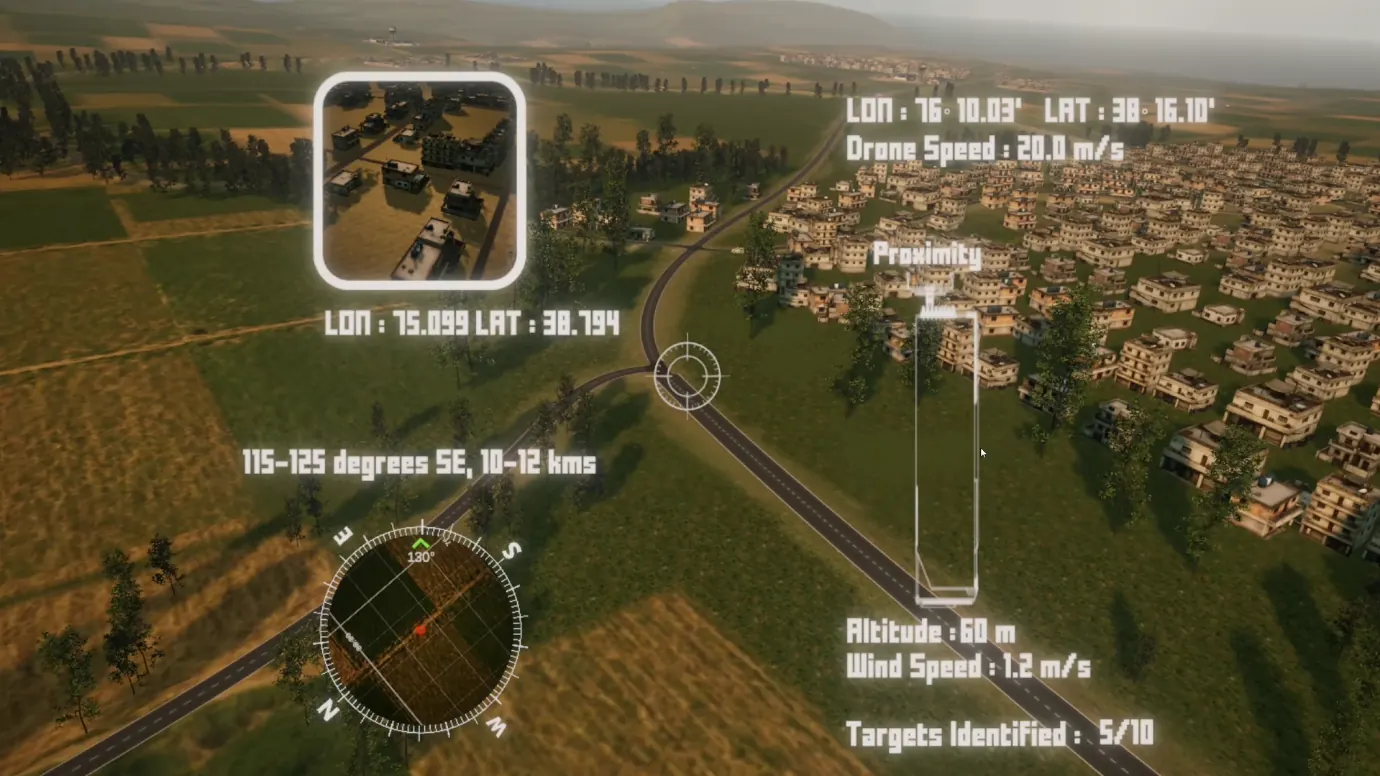
WHAT THE DRONE / UAV SIMULATOR DOES
Modern drone operations require far more than flying. Operators must master flight dynamics, navigation, cameras and sensors, mission planning, ISR, payloads, power management, emergencies, assembly and maintenance — and practise them across desert, plains, mountains, forest and semi-urban terrain, by day and night.
The VR Astra UAV simulator lets operators make their first crash a virtual one. Multirotor and fixed-wing configurations are modelled on the selected platform — mass, motors, battery, payload, sensors, control sensitivity and wind response — and can be flown with the existing physical UAV controller wherever technically feasible.
Instructors build and assign missions, inject wind, fog, rain, night and faults, and review every flight on a performance dashboard. We have already delivered an immersive drone operations simulator for flight, observation and mission-profile familiarisation.
TRAINING CAPABILITIES
Flight training
- Take-off, hover, yaw, pitch, roll, climb, descent and landing
- Precision movement, altitude and heading control
- Restricted-area navigation and obstacle avoidance
- Wind, rain, fog, dust and night conditions
Mission training
- Surveillance and observation of designated areas
- Reconnaissance, navigation and object / target identification
- Inert training-payload delivery procedures
- Instructor-defined mission profiles, routes and events
Multiplayer & team exercises
- UAV pilot, reconnaissance operator and ground coordinator roles
- Shared environment, mission and objectives
- Multi-UAV and squad-level exercises
- Instructor oversight of the entire exercise
Assembly & maintenance
- Assembly, disassembly and pre-flight checks
- Battery handling, transport and storage configuration
- Propeller, motor, sensor and payload-interface inspection
- Motor-fault diagnosis, repair, reassembly and test
SCREENS FROM OUR SIMULATORS
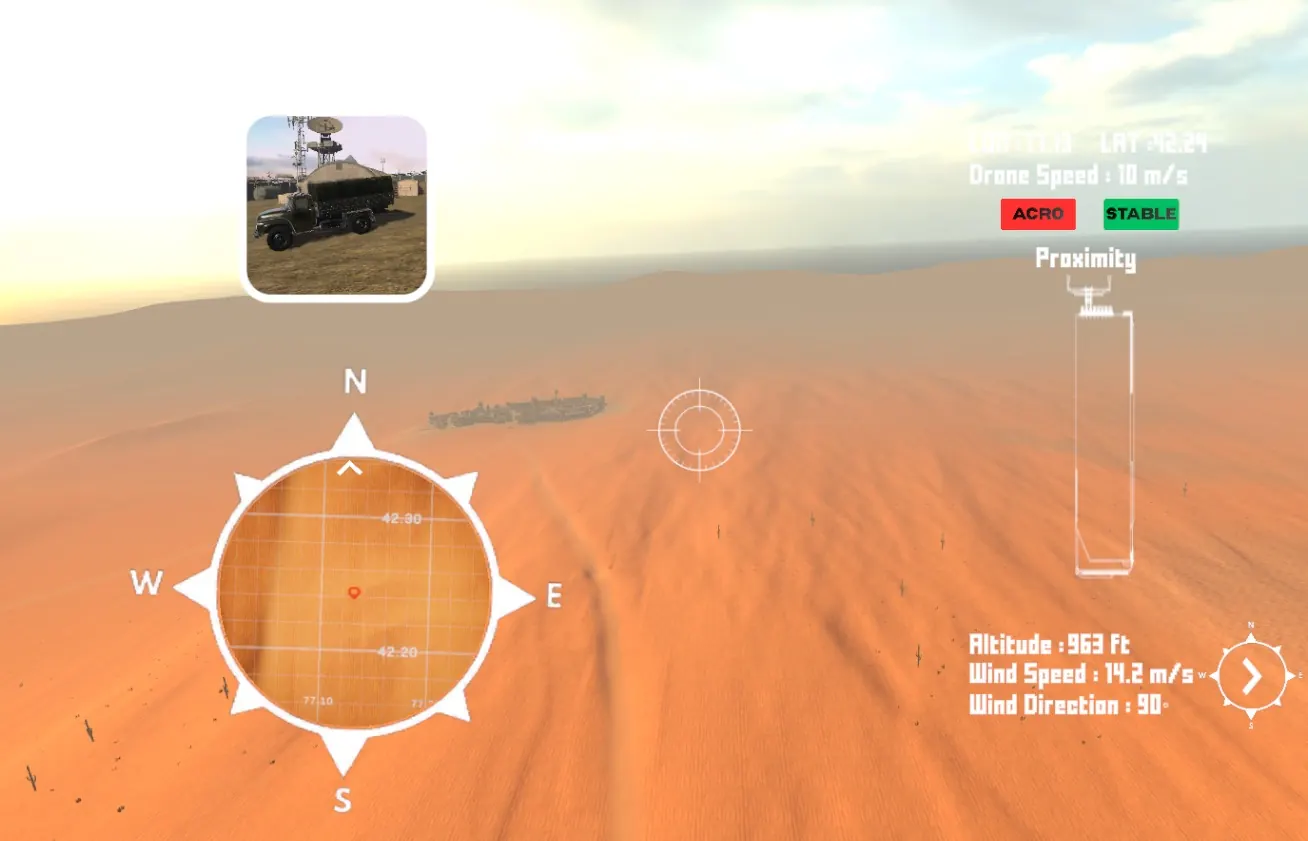
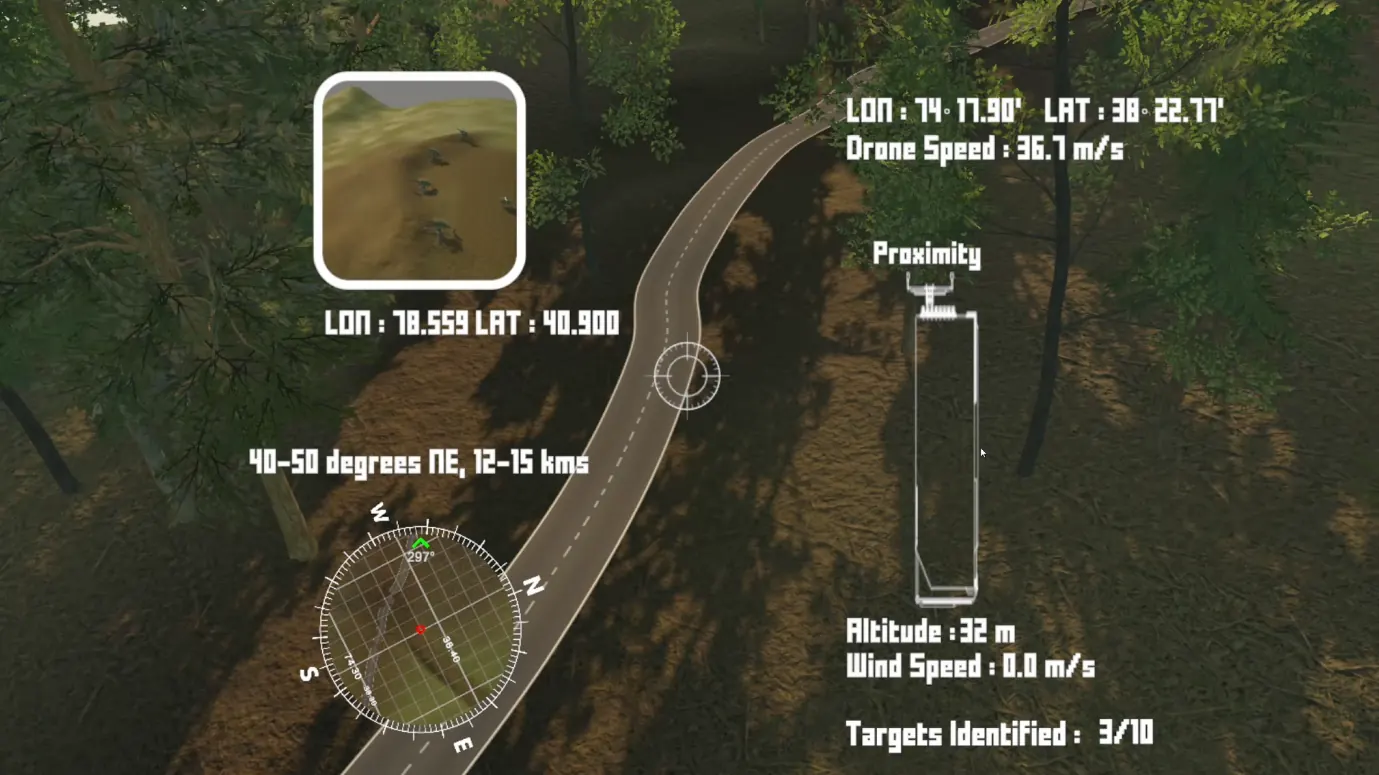
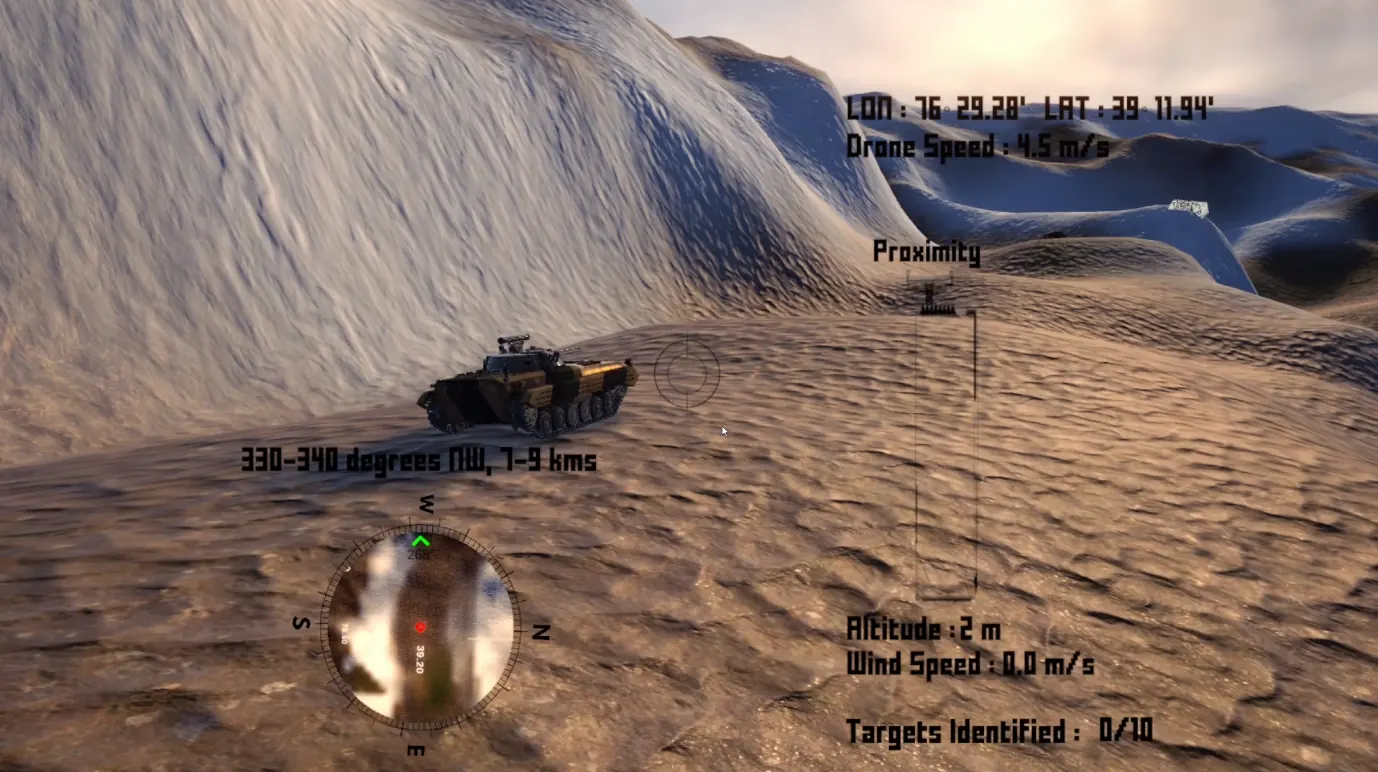
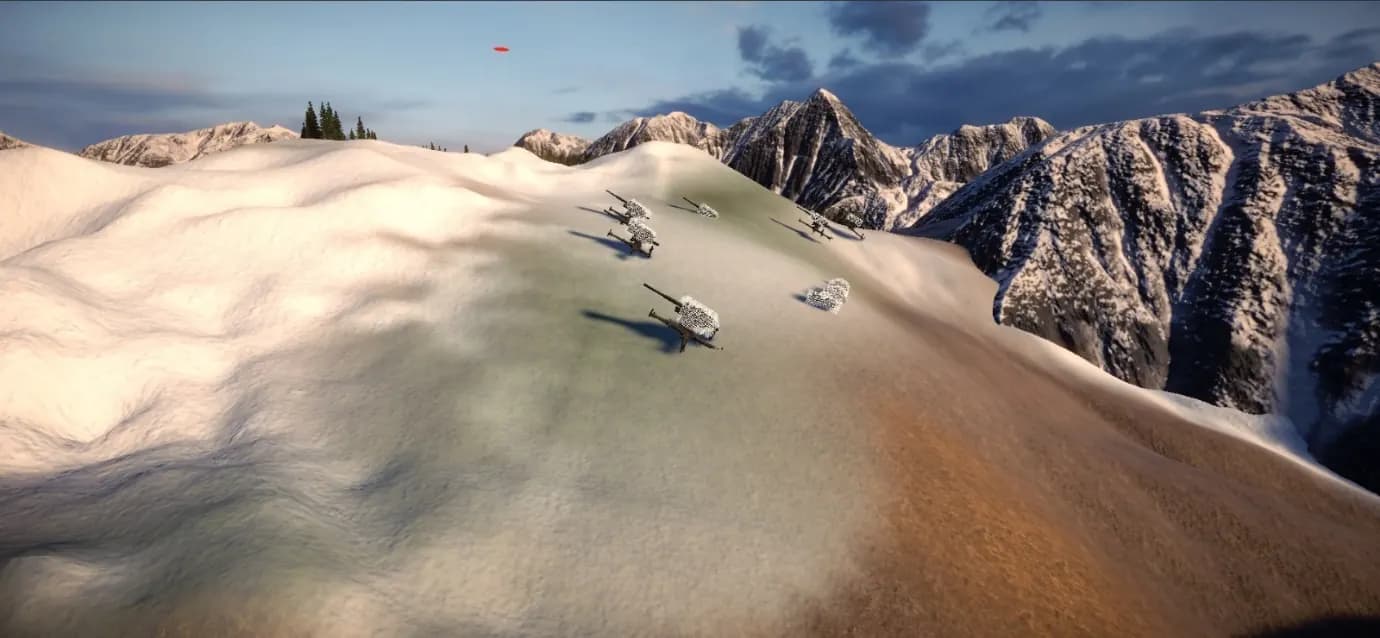
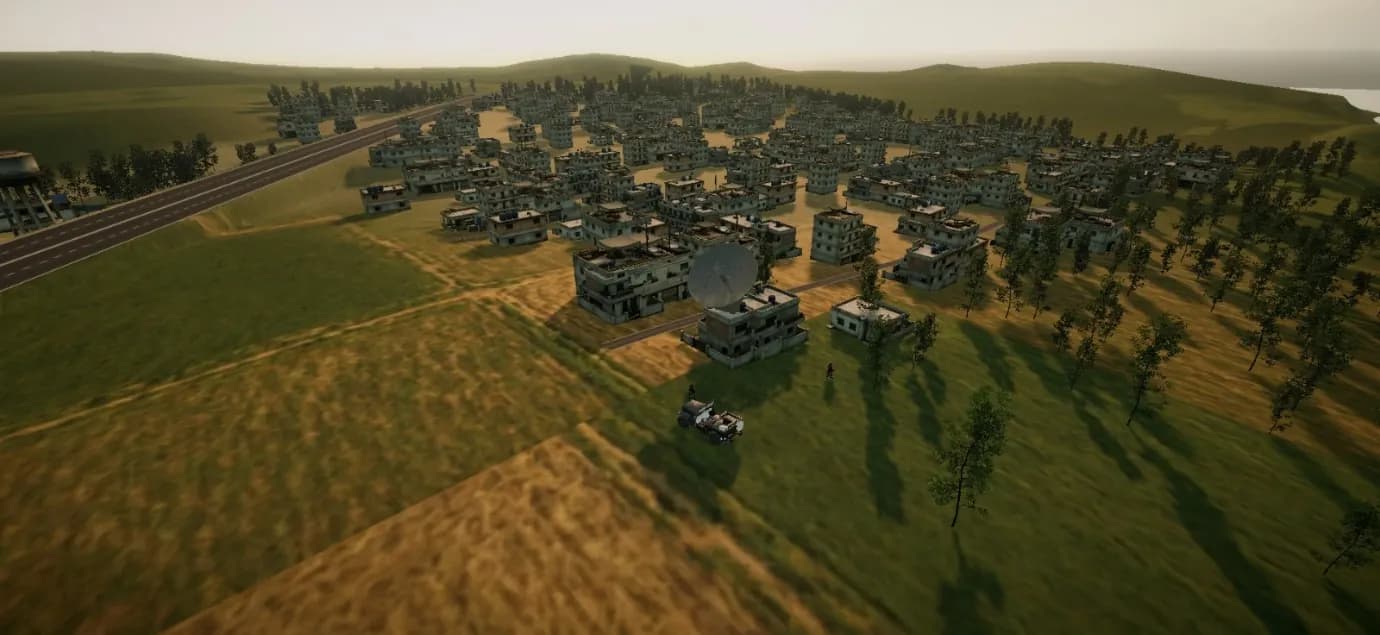
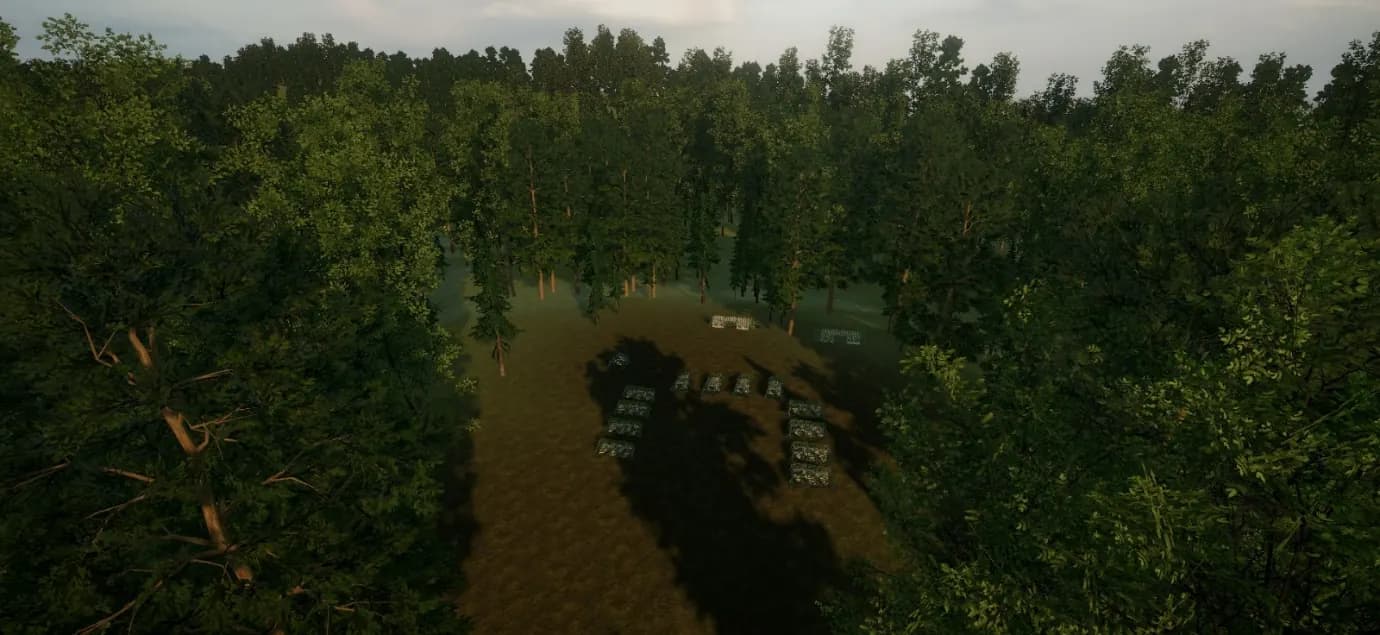
PROPOSED CURRICULUM
| Phase | Indicative time | Focus |
|---|---|---|
| Familiarisation | 2–4 h | Systems, controller, assembly, checks and basic controls. |
| Basic flight | 4–6 h | Take-off, hover, manoeuvring, landing and navigation. |
| Environment | 4–6 h | Wind, rain, fog, night and difficult terrain. |
| Mission training | 4–8 h | ISR, payload procedures, planning and scenarios. |
| Advanced / team | 4–8 h | Multi-UAV, coordination and mission changes. |
| Assessment | as required | Standard assessment, remediation and reassessment. |
Approximately 20–35 hours of indicative simulator exposure, depending on curriculum, platform and mission complexity. Operational readiness is confirmed by supervised real flight.
EVERY SESSION IS MEASURED
- Altitude, position, heading and stability
- Route adherence, waypoint accuracy and area coverage
- Collisions, restricted-area violations and unsafe manoeuvres
- Objective completion and object identification
- Response time to faults and emergencies, flight history and cohort trends
The instructor station creates, assigns and monitors each exercise, injects events and faults in real time, and reviews every attempt. Patterns across attempts show exactly which skill needs remedial training — so trainees repeat the weak skill, not the whole syllabus.
Your doctrine stays yours. Syllabus, procedures, scenarios and assessment criteria are defined by your instructors and SMEs; VR Astra turns them into repeatable, measurable simulation.
DRONE / UAV SIMULATOR — QUESTIONS
What is a UAV training simulator?
A UAV training simulator lets drone operators practise flight, navigation, ISR missions, payload procedures, emergencies and maintenance in a virtual environment before flying the real aircraft. It reduces crash risk, battery and component wear, and dependence on weather and flying areas.
Can we use our existing drone controller with the simulator?
Yes, wherever technically feasible. The existing UAV controller connects through an interface layer to the simulation engine so trainees build muscle memory on the same sticks and switches they will use in the field.
Which drones can be simulated?
Quadcopters, hexacopters and other multirotor configurations, as well as fixed-wing, long-endurance, reconnaissance and survey UAVs. Each is configured for mass, motors, battery, payload, sensors, control sensitivity and wind response of the selected platform.
Does the simulator support team and multi-drone missions?
Yes. Multiple operators share one environment with defined roles — UAV pilot, reconnaissance operator, ground coordinator — while the instructor oversees the whole exercise. Multi-UAV missions are supported.
Is this suitable for police, paramilitary and drone schools?
Yes. Beyond the Army, the same simulator suits CAPF and police drone units, DGCA-oriented training organisations and institutes that want safe, repeatable practice and measurable operator assessment.
How many simulator hours does a drone operator need?
There is no universal number. Our proposed Army pathway is roughly 20–35 hours of simulator exposure, with progression governed by demonstrated competency and final validation on the real UAV.
EXPLORE THE DEFENCE RANGE
Tank & ICV Simulator
BMP-2 driver training, gunnery familiarisation, crew coordination, formation and maintenance. Static, 3DOF and 6DOF.
Military Driving Simulator
4×4s and trucks, convoy and formation driving, difficult terrain, night and weather, emergencies and interactive maintenance. Static, 3DOF, 6DOF.
Case study: BMP-2 driver simulator
How we built a BMP-2 driver training simulator for the Mechanised Infantry Centre & School.
SEE THE DRONE / UAV SIMULATOR LIVE
Demo at your establishment or online. Indigenous, customisable, instructor-controlled.
Prefer to talk right now?
Call or WhatsApp us directly — we usually reply within a few hours on working days.